Macro Architecture and the Reality of the Macro Economy
Macro architecture is justified by the macro economy
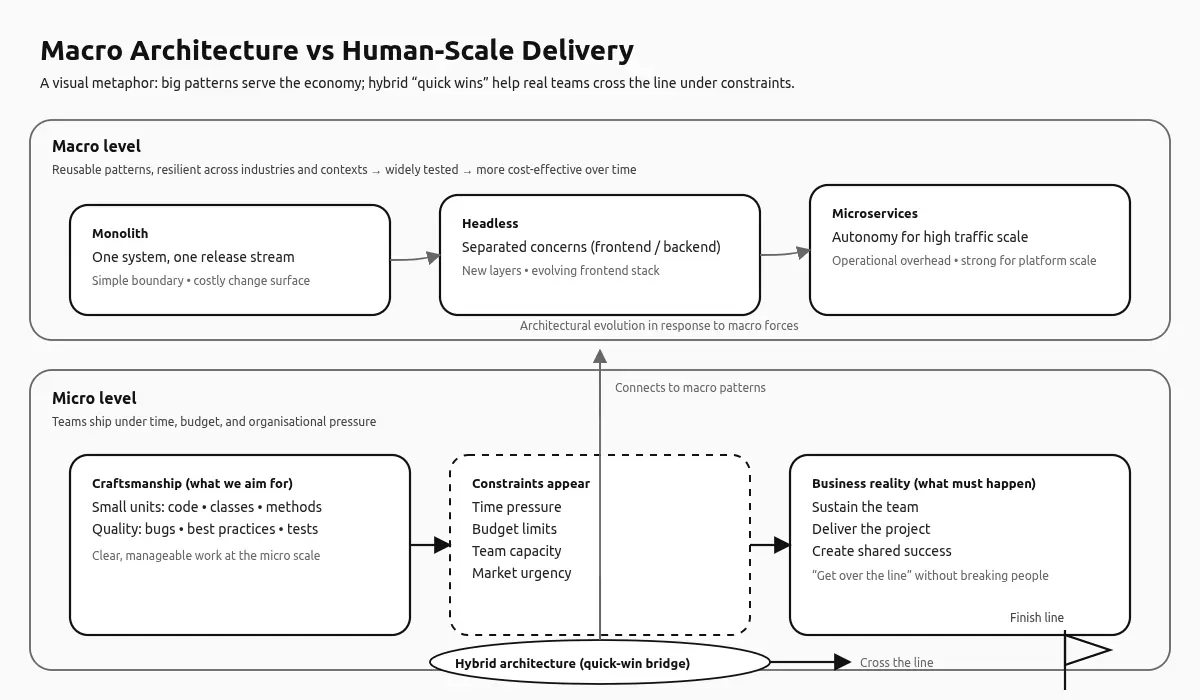
Architectural solutions tend to be strongest at a macro-economy level. Their value lies in reusability across industries and resilience across a wide range of contexts.
Over time, this repeated exposure turns it into a resilient pattern and, eventually, a more cost-effective one.
From Monoliths to Headless and Microservices
Over time, it became clear to me that headless architecture makes sense at a macro level. Twenty years ago, monoliths clearly showed that IT systems become costly when everything lives in a single system. As a very different approach, microservices are now superseding monoliths for high-traffic solutions.
However, for many e-commerce systems, monoliths and headless architectures remain a more practical transition. E-commerce platforms are generally smaller, with tighter teams and constraints, which is why both patterns continue to coexist.
In practice, teams often find themselves working between these two approaches rather than committing fully to either.
Delivery Happens at Human Scale
I have also compared these architectural patterns to how work happens at a micro level. When delivering features, we naturally think small: code, classes, methods. We think about bugs, best practices, and tests. At that scale, craftsmanship feels clear and manageable.
But real projects are not just technical exercises. They are tied to businesses, teams, and livelihoods. Over time, experience teaches us that delivery is not only about writing ideal code, but about helping a project move forward without breaking the people or the organisation behind it.
This is where quick wins come in.
Quick wins are rarely chosen out of laziness. They are often chosen out of care — care for the team that needs to keep going, for the business that needs to ship, and for the project that must cross the line. In those moments, the goal shifts from architectural perfection to shared success.
The takeaway I draw is not that best practices stop mattering, but that context matters more. No two businesses are the same, and no two teams face the same pressures. Pragmatism, when guided by responsibility, becomes a way to deliver value without losing sight of what truly matters.
Pragmatism, Quick Wins, and Crossing the Line
Quick wins can bring value in context, helping the businesses we support to sustain themselves and get over the line with the project at hand. In today’s macro economy, I also believe there is space to deliver small solutions that fit short timescales and help businesses achieve useful outcomes — outcomes that macro solutions like headless or microservices are ultimately designed to support.
Is this reinventing the wheel? No. It is about being hands-on and pragmatic to help businesses get over the line.
At a macro level, many of these quick wins already have a name: hybrid architectures. Most of us have built them, even if we did not label them as such. They combine existing systems with targeted changes, mixing patterns pragmatically rather than replacing everything outright.
These hybrid approaches are not meant to supersede headless rebuilds or microservices architectures. They exist for a different reason. They are designed to help real businesses operating in contexts that do not quite fit macro-level assumptions — businesses constrained by time, budget, teams, or market pressure.
In those situations, a hands-on, quick-win architecture can deliver meaningful value. Not as a final state, but as a way to move forward, reduce risk, and help the business cross the line when larger architectural programmes are neither feasible nor necessary.