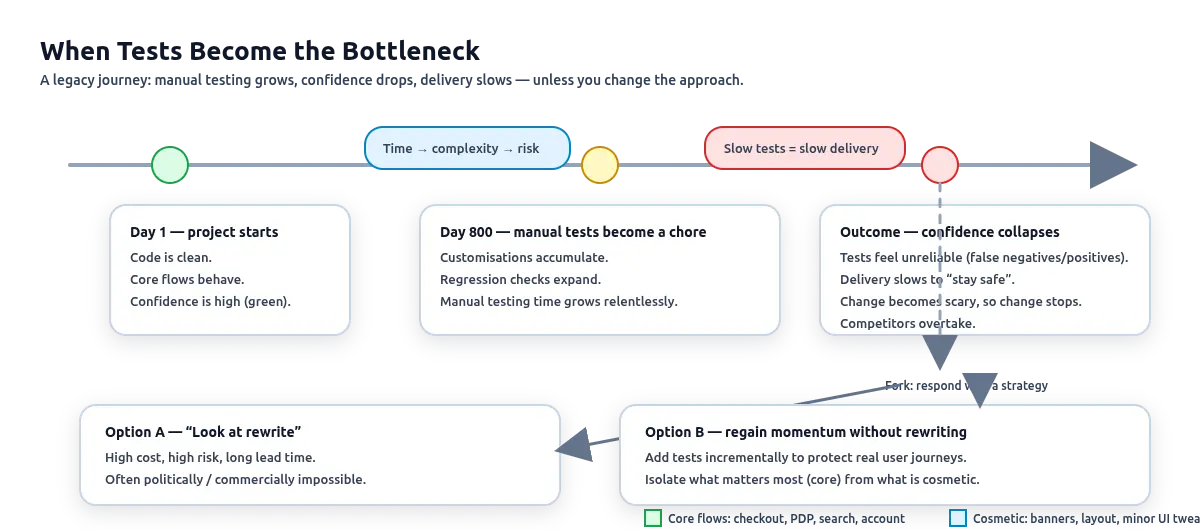
When Tests Become the Bottleneck
A strong start, with the right intentions
It is common for a website project to start with good intentions.
At launch, the codebase is sharp, modules are reviewed, and the business begins to grow. Testing plays an important role in maintaining quality and protecting core functionality. However, when testing is performed manually, its cost grows quickly as the codebase expands and customisations accumulate.
The moment legacy sets in
After two or three years, many legacy platforms find themselves in this exact position.
Manual testing becomes increasingly expensive, yet it still fails to provide reliable confidence. As a result, release cycles slow down to allow teams the time they believe is needed to re-test the entire site, feature by feature, once again.
In practice, this creates a dangerous imbalance.
When confidence turns into hesitation
Teams become reluctant to introduce changes, not because the changes lack value, but because the risk of breaking existing behaviour feels higher than the potential benefit. Over time, the site stops evolving — not due to lack of ideas, but due to fear of unintended regressions.
Why manual testing alone is not enough
Tests are critical, but manual testing alone does not resolve this problem.
What legacy platforms require is a hybrid approach: one that reduces the scope of manual testing, adapts to existing customisations, and restores confidence without forcing a full rewrite or a fragile test strategy. When implemented correctly, testing becomes a mechanism that supports delivery rather than slowing it down.
Testing as part of the delivery architecture
Instead of relying on automated test suites that focus only on platform defaults and ignore real user journeys, testing must be treated as part of the delivery architecture itself. Its purpose is not to prove theoretical correctness, but to enable safe, repeatable change in systems that are already under strain.